
Estimated reading time: 10–13 minutes
Key Takeaways
- The MoRTH Road Safety Policy serves as India’s comprehensive blueprint to drastically reduce road accidents and fatalities.
- It is built upon a multi-pronged strategy encompassing the “5 Es”: Education, Engineering, Enforcement, Emergency Care, and Environment/Equity.
- Key road accident prevention measures include fixing “black spots,” enhancing vehicle safety features, reforming driver licensing, and improving post-crash care.
- Stringent highway safety standards, covering design, signage, lighting, and regular audits, are critical for high-speed roads.
- The policy’s success relies on collaborative efforts from various government agencies, communities, and the responsible behavior of individual road users.
Table of Contents
- Unpacking the MoRTH Road Safety Policy: Essential Road Accident Prevention Measures and Highway Safety Standards in India
- Key Takeaways
- Diving Deep into the MoRTH Road Safety Policy: India’s Blueprint for Safer Journeys
- Crucial Road Accident Prevention Measures: How MoRTH is Making India’s Roads Safer
- Upholding Safety: The Imperative of Highway Safety Standards
- A Collaborative Journey Towards Safer Roads: The Future of MoRTH’s Vision
- Frequently Asked Questions
India’s roads, bustling with life and movement, unfortunately also face a significant challenge: road safety. The country grapples with one of the highest numbers of road accidents and related fatalities globally. Each year, over 1.5 lakh lives are tragically lost, and many more lakhs of individuals are injured. This alarming statistic, confirmed by MoRTH’s annual reports, carries immense economic, social, and deeply personal human costs, making safe travel a critical public health and development priority for the nation.
Ministry of Road Transport and Highways (MoRTH) annual reports (“Road Accidents in India”) state over 1.5 lakh lives lost annually.
This is where the Ministry of Road Transport and Highways (MoRTH) steps in. As the leading government body, MoRTH is in charge of setting up and managing all the rules, regulations, and policies related to road transport, national highways, and road safety across India. It plays a vital role in planning and putting into action strategies aimed at making our roads much safer.
The purpose of this blog post is to make sense of MoRTH’s wide-ranging approach to road safety. We will look closely at its policy framework, the specific road accident prevention measures it introduces, and the important highway safety standards it insists upon for roads and highways. By understanding the MoRTH road safety policy in detail, we hope to shed light on how India is working towards a safer road environment for everyone. Our insights are drawn from official and reputable sources to give you the most accurate picture.
Diving Deep into the MoRTH Road Safety Policy: India’s Blueprint for Safer Journeys
India’s commitment to reducing road mishaps and ensuring safer travel is enshrined in the MoRTH Road Safety Policy. This foundational document, often referred to as the National Road Safety Policy, outlines a strategic framework to tackle the complex challenges of road safety. It serves as India’s guiding blueprint, ensuring that every journey on its vast road network becomes progressively safer.
Overview of the Policy
The MoRTH Road Safety Policy is built upon clear aspirations and a robust plan of action. It’s more than just a set of rules; it’s a vision for the future of Indian roads.
- Vision: The ultimate goal of this crucial policy is to drastically cut down the number of road collisions and related deaths in India. It aims for nothing less than zero fatalities, striving to protect every life on the road. This forward-looking approach seeks to create an environment where road travel is inherently secure.
- Mission: To achieve this ambitious vision, the policy employs a comprehensive, multi-pronged strategy. This strategy focuses on five key areas, often known as the “5 Es”: Education, Engineering, Enforcement, Emergency care, and Environment/Equity. By addressing these diverse aspects, the mission is to build a strong culture of road safety across the country.
- Goals: The policy, first formulated in 2010 but continuously updated with new action plans, sets specific targets for reducing road accident deaths and injuries. These targets often align with global commitments, such as the UN Decade of Action for Road Safety. For instance, India is a signatory to the Brasilia Declaration, which aims for a 50% reduction in road crash fatalities by 2030. This overarching strategy takes a holistic and integrated view, involving many different groups and individuals to work together towards common safety objectives.
The Five Key Pillars (5 Es) of the Policy
The success of the MoRTH road safety policy hinges on its five strategic pillars. These “Es” represent a holistic framework for accident prevention and mitigation, addressing various facets of road safety management.
- Education: This pillar focuses on spreading knowledge and awareness about safe road practices. It involves widespread public campaigns, integrating road safety into school curricula, and offering specialized training programs for drivers and other road users. The aim is to instill safe habits and a sense of responsibility in everyone who uses the road network.
- Engineering (Road & Vehicle): This aspect deals with improving the physical design of roads and vehicles. On the road front, it involves enhancing infrastructure, such as better road geometry, and identifying and fixing dangerous accident-prone locations, often called “black spots.” For vehicles, it means setting and enforcing higher safety standards and encouraging the adoption of advanced safety technologies in automobiles.
- Enforcement: This pillar is about ensuring that traffic laws and regulations are strictly followed. It involves robust implementation of traffic rules, handing out penalties for violations, and using better surveillance systems to monitor compliance. Strong enforcement acts as a deterrent, encouraging adherence to safe driving practices.
- Emergency Care: This critical pillar concentrates on improving the response and care given to accident victims immediately after a crash. It includes strengthening pre-hospital services like ambulance networks and setting up well-equipped trauma care facilities in hospitals. The goal is to provide swift and effective medical attention, which can be life-saving.
- Environment (or Equity/Engagement): This pillar looks at the broader factors that influence road safety. It includes aspects like urban planning, promoting public transportation to reduce individual vehicle use, and encouraging public participation. It also emphasizes equitable access to safe roads for all users and fostering collaboration among different government agencies, communities, and individuals to create a safer road ecosystem.
Historical Context and Necessity
The development of the MoRTH road safety policy was not a sudden event but a critical response to a growing national crisis. India has experienced rapid growth in motorization over the past few decades, with an increasing number of vehicles on its roads. Unfortunately, this surge was often coupled with outdated or insufficient road infrastructure and a worrying lack of adherence to safety guidelines by many road users.
This combination led to an alarming rise in road crashes and fatalities. It became evident that fragmented or one-off interventions were not enough. A comprehensive, nationwide policy framework was desperately needed to address this complex challenge systematically. The MoRTH road safety policy emerged from this necessity, aiming to bring together various efforts, clearly define responsibilities, and set precise goals for enhancing road safety across the entire country. It marked a crucial shift towards a more coordinated, strategic, and holistic approach to making India’s roads safer for everyone.
Crucial Road Accident Prevention Measures: How MoRTH is Making India’s Roads Safer
MoRTH is actively engaged in a wide array of initiatives and interventions designed specifically as road accident prevention measures. These efforts span across improving physical infrastructure, enhancing vehicle safety, educating drivers, and strengthening post-crash response systems. The goal is to tackle the root causes of accidents and minimize their devastating impact.
Safer Road Infrastructure
One of the most direct ways to prevent accidents is by making roads themselves safer. MoRTH has several programs focused on improving the physical environment of India’s highways and roads.
- Black Spot Identification & Rectification: MoRTH has a dedicated program to pinpoint and fix accident “black spots.” These are specific stretches of road where a disproportionately high number of road incidents occur. Engineers analyze data to identify these hazardous locations and then implement targeted improvements. These interventions might include redesigning road geometry, installing clearer signage, enhancing road markings, or putting up stronger crash barriers. This data-driven approach ensures that resources are focused where they are most needed to improve safety.
- Improved Road Design: Adhering to strict Indian Road Congress (IRC) standards is fundamental for all new road construction and upgrades. These standards ensure that roads are designed with safety in mind from the ground up. This involves incorporating features such as adequate lane widths, which allow vehicles sufficient space, and paved shoulders, providing a safe recovery area or emergency stopping lane. Proper horizontal and vertical alignment ensures smooth transitions, while sufficient sight distances give drivers enough time to react to hazards. These thoughtful design elements are essential road accident prevention measures.
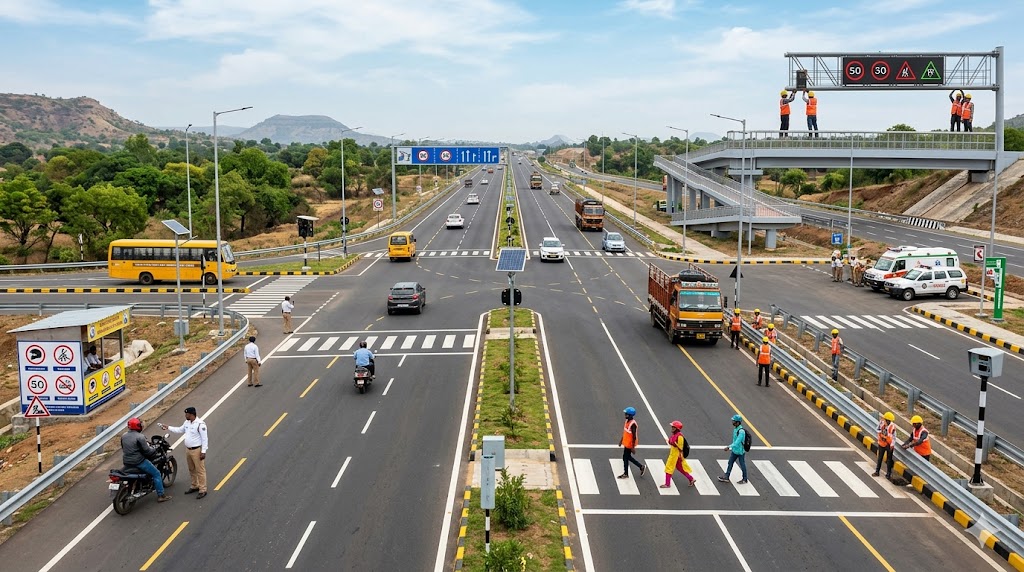
- Intelligent Transport Systems (ITS): MoRTH is increasingly deploying smart technologies to enhance road safety and manage traffic flow. These Intelligent Transport Systems (ITS) include advanced traffic management systems that optimize signals and traffic flow, and variable message signs that provide real-time information to drivers. Technologies like speed detection cameras, automatic number plate recognition (ANPR), and incident detection systems help enforce traffic laws and enable quick responses to accidents or emergencies. These systems contribute significantly to dynamic traffic safety and incident reduction.
- Pedestrian-Friendly Infrastructure: Recognizing the vulnerability of pedestrians and cyclists, MoRTH promotes initiatives to create dedicated safe spaces for them. This includes building well-maintained footpaths, clearly marked pedestrian crossings, and structures like skywalks and underpasses. Dedicated cycle tracks are also being constructed, especially in urban and suburban areas alongside highways. The aim is to physically separate vulnerable road users from fast-moving vehicular traffic, thereby significantly reducing the risk of collisions and enhancing their safety on busy thoroughfares.
Safer Vehicles
Another critical area for road accident prevention measures involves improving the safety features of vehicles themselves. MoRTH is proactive in setting and enforcing regulations for vehicle manufacturers.
- Regulations on Vehicle Safety Features: Through amendments to the Central Motor Vehicles Rules (CMVR), MoRTH has mandated several essential safety features in vehicles. For two-wheelers, this includes Anti-lock Braking System (ABS) or combined braking system (CBS) to prevent skidding. In cars, airbags for both the driver and co-driver, reverse parking sensors, speed alert systems, and seatbelt reminders are now compulsory. Additionally, India is introducing the Bharat NCAP (New Car Assessment Program), which will provide star ratings for car safety, empowering consumers to make informed choices about safer vehicles. These mandates are crucial in raising the baseline safety standards of the entire vehicle fleet.
- Vehicle Fitness Testing: To ensure that vehicles remain roadworthy throughout their lifespan, MoRTH emphasizes rigorous periodic fitness testing, particularly for commercial vehicles. Automated vehicle inspection and certification centers are being established to conduct thorough checks on critical components such as brakes, steering, lighting systems, and emissions. This systematic inspection process helps in taking unsafe vehicles off the road, thereby preventing accidents caused by mechanical failures.
Safer Drivers
Human error is a major contributing factor to road accidents. Therefore, focusing on educating and regulating drivers is a cornerstone of road accident prevention measures.
- Reforms in Driving License Issuance: MoRTH has introduced significant reforms to make the process of obtaining a driving license more stringent and accurate. This includes the use of computerized driving test tracks, which offer a standardized and objective assessment of driving skills. There is also a strong emphasis on promoting accredited driver training schools to ensure that new drivers receive systematic and standardized training before they get behind the wheel, making them more competent and safety-conscious.
- Driver Training Programs: Beyond initial licensing, MoRTH actively supports ongoing training programs, especially for commercial vehicle drivers. These programs, often in partnership with state transport undertakings, focus on crucial aspects like defensive driving techniques, fatigue management to prevent drowsy driving, and strict adherence to traffic rules. Enhancing professional driver skills directly contributes to fewer incidents on the road.
- Public Awareness Campaigns: MoRTH conducts extensive public awareness campaigns across various media platforms – print, electronic, and social media. These campaigns tackle critical unsafe behaviors such as drunk driving, overspeeding, and distracted driving (especially mobile phone use). They also vigorously promote mandatory safety practices, like wearing helmets for two-wheeler riders and seatbelts for all vehicle occupants. A prominent example is the “Sadak Suraksha Jeevan Raksha” (Road Safety, Life Protection) campaign, which constantly reminds citizens about their role in ensuring road safety.
Post-Crash Care
Even with the best prevention efforts, accidents can still happen. Effective post-crash care is vital to minimize fatalities and injuries. This forms another essential component of road accident prevention measures.
- Enhancements in Emergency Medical Services: MoRTH is working towards developing a robust national accident helpline, such as 112, which can be seamlessly integrated with ambulance services. The plan includes establishing a comprehensive network of ambulances specifically equipped for trauma care, ensuring rapid deployment to accident sites and professional medical assistance.
- Trauma Care Facilities: Along national highways and in district hospitals, MoRTH supports the upgrading and establishment of specialized trauma care centers. These facilities are designed to provide immediate and expert medical attention to accident victims, often through dedicated government schemes. This specialized care is critical in saving lives and reducing the long-term impact of injuries.
- “Golden Hour” Management: A key focus is on managing the “golden hour” – the critical first hour after an accident. Reducing response time and providing immediate medical intervention within this period can significantly improve survival rates and lessen the severity of injuries. To encourage public assistance, laws are in place to protect “Good Samaritans” who come forward to help accident victims, fostering a community spirit of aid in emergencies.
Upholding Safety: The Imperative of Highway Safety Standards
Highways are the arteries of a nation, carrying heavy traffic and high speeds. Therefore, maintaining stringent highway safety standards on these crucial roads is not merely a recommendation but an absolute necessity for preventing accidents and ensuring the well-being of all road users. MoRTH plays a pivotal role in establishing, promoting, and enforcing these rigorous standards.
Specific Focus on Highway Safety Standards
MoRTH, operating through its various specialized wings and in close cooperation with the Indian Road Congress (IRC), develops and enforces comprehensive guidelines. These guidelines cover every aspect of National Highways: from their initial design and construction to their ongoing maintenance and daily operation. Furthermore, MoRTH strongly encourages state governments to adopt similar robust standards for their respective State Highways. These specific highway safety standards are fundamental. They are meticulously crafted to proactively prevent incidents and significantly reduce the severity of injuries should a collision occur. They are the backbone of a safe road network.
Design Standards
The initial design of a highway is paramount to its safety. MoRTH mandates adherence to specific design principles to minimize risks.
- Lane Width, Shoulder Design: Standards prescribe uniform and adequate lane widths for highways, typically 3.5 meters for National Highways. Equally important is the provision of adequate paved and unpaved shoulders. These shoulders are not just for aesthetic appeal; they serve as critical recovery spaces for vehicles that might stray from their lane, and provide safe areas for emergency stops or disabled vehicles, preventing further hazards.
- Median Barriers, Crash Barriers: On divided highways, the installation of median barriers is mandatory. These can be made of concrete or metal beams and are designed to prevent head-on collisions by stopping vehicles from crossing into opposing traffic lanes. Similarly, crash barriers, such as W-beam or wire rope barriers, are strategically placed along curves, high embankments, and near fixed obstacles. Their purpose is to absorb the impact of errant vehicles and redirect them safely back onto the roadway or prevent them from plunging off the road.
- Clear Zones: Maintaining clear zones adjacent to the main travelled way is a crucial design standard. These are areas free of rigid obstacles like trees, utility poles, or unyielding structures. If a vehicle leaves the road, a clear zone provides a safe space for the driver to recover control or slow down safely without hitting a fixed object. This passive safety feature significantly reduces the severity of potential crashes.
- Geometric Design: Strict guidelines are enforced for various geometric elements of the highway. This includes the design of horizontal curves (bends in the road), vertical grades (slopes), sight distance (how far a driver can see ahead), and intersection layouts. These precise guidelines ensure smooth and predictable traffic flow, minimize surprises for drivers, and reduce conflict points, all contributing to overall road safety and adherence to high highway safety standards.
Signage and Delineation
Clear and consistent visual cues are vital for driver guidance and safety, especially on fast-moving highways.
- Clear Road Markings: The use of highly reflective thermoplastic paint is standard for all road markings. This includes lane markings, edge lines, centre lines, pedestrian crossings, and rumble strips. These markings provide clear guidance to drivers, define traffic lanes, and alert them to approaching hazards. Their retro-reflective properties enhance visibility, especially at night and during adverse weather conditions like rain or fog, which is a key part of highway safety standards.
- Reflective Signages: All cautionary, regulatory, and informatory signs on highways are standardized and must be reflective, as per IRC standards. These signs convey vital information, warnings, and instructions to drivers in an easily understandable format. There’s also an increasing trend towards using digital dynamic message signs, which can provide real-time updates on traffic conditions, incidents, or weather warnings, significantly improving driver awareness and reaction time.
- Cat’s Eyes (Road Studs): The installation of reflective road studs, commonly known as “cat’s eyes,” is a simple yet effective measure. These studs are embedded in the road surface to clearly delineate carriageway edges and medians. They provide crucial visual guidance to drivers during low-light conditions, heavy rain, or fog, helping them stay within their lanes and maintain proper road positioning.
Lighting and Surveillance
Adequate visibility and constant monitoring are critical components of maintaining high highway safety standards.
- Adequate Lighting: MoRTH’s standards include provisions for sufficient street lighting at specific critical sections of highways. These typically include urban stretches where highways pass through towns, toll plazas, complex intersections, flyovers, and tunnels. Good lighting significantly improves visibility for drivers, reduces glare, and enhances safety during nighttime, helping to prevent nocturnal accidents.
- Surveillance Systems: The implementation of advanced surveillance systems is becoming increasingly common. This involves deploying CCTV cameras and Automatic Traffic Counter cum Classifier (ATCC) systems. These technologies allow authorities to continuously monitor traffic flow, detect incidents like breakdowns or accidents quickly, identify traffic violations, and facilitate a rapid response by emergency services or law enforcement, thus boosting overall highway security.
Role of Regular Audits and Inspections
To ensure that these high highway safety standards are consistently met and maintained, MoRTH mandates a system of regular checks and evaluations. This is a proactive road accident prevention measure.
MoRTH requires periodic road safety audits for all new highway projects and significant upgrades… In addition to these audits, regular maintenance inspections are carried out to confirm that all infrastructure elements, such as signs, road markings, barriers, and lighting, are in excellent condition and fully comply with the established highway safety standards. These comprehensive audits and inspections are vital for identifying deficiencies, ensuring strict compliance with safety guidelines, and making a significant contribution to the overall effectiveness of road accident prevention measures.
A Collaborative Journey Towards Safer Roads: The Future of MoRTH’s Vision
The journey towards safer roads in India is a monumental undertaking, but one that the MoRTH Road Safety Policy addresses with remarkable clarity and commitment. By examining its framework, we see a truly comprehensive, multi-sectoral strategy at play. This policy rightly recognizes that road safety isn’t simply a matter of engineering; it’s deeply intertwined with human behavior, advancements in vehicle technology, and the efficiency of post-crash emergency response. Its five core pillars—Education, Engineering, Enforcement, Emergency Care, and Environment—collectively encompass all critical dimensions of making our road network safer for everyone.
The effectiveness of this strategic approach hinges on the indispensable link between robust road accident prevention measures and stringent highway safety standards. Initiatives like comprehensive driver training, mandatory vehicle safety features, and the critical rectification of accident-prone “black spots” work hand-in-hand with rigorous highway design, clear signage, effective barriers, and proper lighting. One cannot truly be effective without the other; they are mutually reinforcing. Strong safety standards provide the secure infrastructure, while preventative measures ensure that users interact with this infrastructure responsibly, leading to a significant reduction in accidents and their severity.
While MoRTH leads the charge in strategizing and implementing this national road safety vision, the ultimate success of the MoRTH Road Safety Policy is a shared responsibility. It depends on the sustained commitment and collaborative efforts of numerous stakeholders. This includes various government agencies at state levels, such as transport departments, police forces, and health authorities. Local municipal bodies, vehicle manufacturers, and educational institutions all have crucial roles to play. Most importantly, the policy’s success relies on the responsible behavior of individual road users. By working together – agencies upholding standards, communities promoting awareness, and individuals practicing caution – we can collectively realize the vision of significantly safer, and perhaps even zero-fatality, roads across India.
Frequently Asked Questions
- What is the primary goal of the MoRTH Road Safety Policy?
The primary goal is to significantly reduce road accidents and fatalities in India, striving towards a vision of zero fatalities on Indian roads. It aims to achieve this through a comprehensive, multi-pronged strategy focusing on education, engineering, enforcement, emergency care, and environment/equity.
- How do “black spots” contribute to road safety and what is MoRTH doing about them?
Road accident “black spots” are specific locations where a high concentration of accidents occur. These spots indicate underlying design flaws or hazardous conditions. MoRTH addresses them through a dedicated program that involves identifying these locations using data analysis and implementing targeted engineering improvements to rectify the deficiencies and enhance safety.
- Are vehicle safety features mandated in India?
Yes, MoRTH, through amendments to the Central Motor Vehicles Rules (CMVR), has mandated several essential safety features. These include ABS/CBS for two-wheelers, and airbags, reverse parking sensors, speed alert systems, and seatbelt reminders for cars. India is also introducing the Bharat NCAP to provide safety ratings for vehicles.
- What role do Intelligent Transport Systems (ITS) play in highway safety?
Intelligent Transport Systems (ITS) enhance highway safety by deploying smart technologies such as advanced traffic management systems, variable message signs, speed detection cameras, and incident detection systems. These systems help manage traffic flow, provide real-time information to drivers, enforce laws, and enable quicker responses to incidents, contributing to dynamic traffic safety.
- How important is public participation in the success of MoRTH’s road safety vision?
Public participation is crucial. While MoRTH sets policies and standards, the ultimate success depends on the responsible behavior of individual road users – adhering to traffic rules, practicing safe driving, and being aware of safety measures. Public awareness campaigns and community engagement initiatives are vital components of the policy to foster a culture of road safety.