Estimated reading time: 15 minutes
Key Takeaways
- *Accurate and complete documentation* is crucial for timely NHAI permission approval, avoiding delays and rejections.
- The Land Management System (LMS) portal is the primary digital platform for all NHAI applications.
- Permissions are required for *various activities* including access, utility laying, temporary use, and way-side amenities near National Highways.
- *General document categories* include identification, land ownership, project proposals, technical drawings, and No Objection Certificates (NOCs) from other authorities.
- Following the LMS portal’s auto-generated checklist and adhering to submission best practices (attestation, correct format, organization) are vital for a smooth process.
Table of contents
- NHAI Required Documents: A Comprehensive Summary for Permission Applications
- Key Takeaways
- Understanding NHAI Permissions and the Documentation Imperative
- General Categories of NHAI Required Documents
- Applicant Identification & Address Proofs
- Proof of Land Ownership/Right to Use
- Project Proposal/Scope of Work
- Technical Drawings and Maps
- No Objection Certificates (NOCs) from Other Authorities
- Detailed Breakdown: Specific Documents for Key NHAI Applications
- For Right of Way (ROW) Documentation (e.g., Utility Laying, Temporary Use)
- For Access Permit Papers
- Other Permission Application Documents
- Navigating the Approval Document Checklist
- LMS Portal Functionality
- Importance of the Checklist
- How to Utilize the Checklist
- Common Pitfalls
- Obtaining and Completing the Application Form NHAI
- Online Process
- Accuracy Requirement
- Annexures/Supplementary Forms
- Essential NHAI Paperwork Requirements and Submission Best Practices
- Self-Attestation/Notarization
- Format
- Number of Copies
- Organizing Documents
- Submission Process
- Record-Keeping
- Conclusion
- Frequently Asked Questions (FAQ)
The National Highways Authority of India (NHAI) plays a huge role in building and looking after India’s big national roads. Think of NHAI as the main caretaker for these important roadways that connect cities and towns across the country. They work hard to make sure our journeys are smooth and safe.
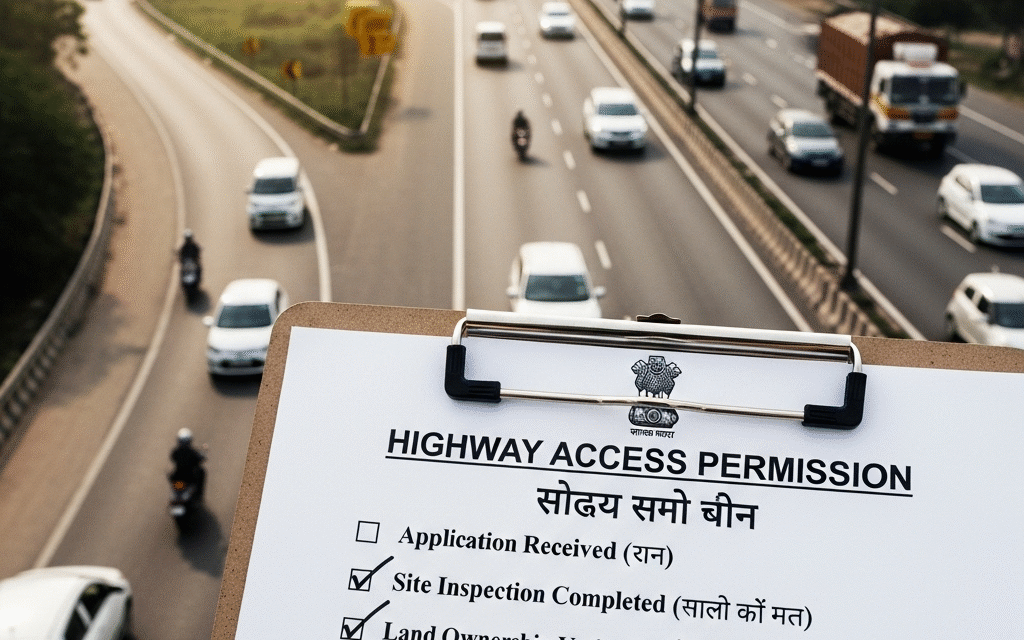
If you want to do anything that touches these national roads or the land next to them, you usually need a special green light from NHAI. This could be for building a new shop, putting in water pipes, or even having a temporary construction area. Getting this formal permission is a must for almost any activity that impacts the National Highway Right of Way (ROW). The ROW is simply the land area that NHAI controls for the highway and its future expansion.
The secret to getting these permissions quickly and without problems is having all your papers in order. Accurate and complete documentation is the solid foundation for getting your approval on time. It helps you avoid delays that can cost a lot of money and time. Without the right papers, your application might get stuck or even sent back.
This easy-to-understand guide is here to help you. It aims to make clear all the essential paperwork you need. We will help you streamline the permission application documents process and simplify the NHAI paperwork requirements. Our goal is to make your approval journey as smooth as possible, guiding you through every step.
Understanding NHAI Permissions and the Documentation Imperative
Imagine you want to build something or put a utility line near a big national highway. You can’t just start digging! You need special permission from NHAI. Luckily, NHAI has made things much easier with its digital platform, the Land Management System (LMS) portal. You can find it at lms.nhai.gov.in. This online system has changed how people apply, making the process mostly digital and much more streamlined. It’s like an online desk where you can submit all your requests. You can learn more about this digital process in the NHAI e-Portal Digital Permissions Guide.
There are many common reasons why people need to get permission from NHAI. These reasons cover a wide range of activities that might touch the national highways. Understanding these helps you know which kind of approval you might need.
Here are some typical situations that call for NHAI permissions:
-
- Access Permission: This is needed if you want to create an entry or exit point from a National Highway to your property. Whether it’s a shop, a house, or a factory, if your driveway or road connects to the highway, you need this permission. This ensures everyone can get in and out safely.
-
- Utility Laying Permission: This is for putting in important services like fibre optic cables (for internet), power lines (for electricity), water pipes, or gas pipes. If these lines need to go under or across the highway land (the ROW), you must get NHAI’s consent. This avoids damage to the road and makes sure services are installed correctly.
-
- Temporary Use Permission: Sometimes, you might need to use a small part of the highway land for a short time. This could be for putting up temporary signs, advertising boards, or even having a staging area for big construction projects. This permission makes sure your temporary use doesn’t block traffic or cause hazards.
-
- Minor Mining Permission: In some cases, people need to extract small amounts of minerals, like sand or gravel, from within the highway’s land. This is less common but still requires a specific permit to ensure it’s done responsibly and doesn’t affect the road’s structure.
- Way-side Amenities: These are facilities that make travel easier for drivers, such as petrol pumps, motels, restaurants, and service stations. If you plan to build one of these next to a National Highway, you’ll need specific approvals to ensure proper access and safety for road users.
It’s super important to have accurate and complete documentation when you apply. Why? Because NHAI checks every application very carefully. They want to make sure your plans follow all the technical rules, safety guidelines, and legal requirements. If your papers are not correct, or if something is missing, it’s the main reason applications get rejected or cause long delays. So, getting your papers right from the start is key to a smooth journey through the approval process. Proper documentation is a non-negotiable part of securing your necessary approvals.
General Categories of NHAI Required Documents
While the exact papers you need can change depending on what kind of permission you are asking for, there are some types of documents that NHAI usually asks for in almost all NHAI required documents submissions. Knowing these common requirements can really help to simplify the overall NHAI paperwork requirements. Think of these as the basic building blocks for any application.
Let’s look at these general categories:
Applicant Identification & Address Proofs
NHAI needs to know exactly who is applying. This proves you are who you say you are and shows where you live or where your company is based.
-
- For Individuals (like a single person):
- Aadhaar Card: This is a unique identification number for Indian residents.
- PAN Card: Your Permanent Account Number, mainly for taxes.
- Voter ID: Your election identity card.
- Passport: An international travel document that also serves as ID.
- Proof of Residential Address: Documents like electricity bills, phone bills, or a bank statement that show your home address.
- For Individuals (like a single person):
- For Corporate/Entity (like a company or business):
- Certificate of Incorporation: The document that proves your company is legally registered.
- Memorandum & Articles of Association: These are the foundational legal documents of your company, outlining its purpose and how it operates.
- PAN Card of the entity: The tax ID for your company.
- Board Resolution authorizing the signatory: A formal decision made by the company’s directors that says who is allowed to sign papers for the application.
- Power of Attorney for the authorized representative: A legal document that gives someone the authority to act on behalf of the company.
Proof of Land Ownership/Right to Use
You need to show NHAI that you legally own the land or have the right to use the land that is next to the highway or where your project will be. This is crucial for verifying your claim over the property.
-
- Legal Title:
- Sale Deed: A legal document showing you bought the land.
- Lease Deed: A document showing you are renting or leasing the land.
- Gift Deed: A document showing the land was given to you as a gift.
- Or any other paper that clearly shows you own or have the legal right to use the land that touches the National Highway Right of Way (ROW). These documents establish your legal right over the property.
- Legal Title:
-
- Revenue Records:
- Latest revenue records (e.g., Khasra/Khatauni/ROR): These are official land records from the local government that show who owns the land and its details.
- Mutation records: Papers that show a change in ownership of the land.
- Revenue Records:
- Site Plan:
- A map or drawing of your property that clearly shows where your land ends and where the National Highway land (ROW) begins. This drawing helps visualize the interface between your project and the highway.
Project Proposal/Scope of Work
NHAI needs to understand exactly what you plan to do. These papers explain your project in detail.
-
- Detailed Project Report (DPR): This is a complete write-up that explains everything about your proposed activity. It covers why you want to do it, what you will do, how you will do it, and what materials you will use. This comprehensive document is essential for NHAI to evaluate the project’s feasibility and impact. You can find more information about DPR for National Highway Projects here.
- Detailed cost estimates: A breakdown of how much money you expect to spend on the project. This gives NHAI an idea of the project’s scale and financial commitment.
Technical Drawings and Maps
These are visual plans that show how your project will look and fit with the highway. They must be very precise. These design plans are vital for NHAI’s technical assessment.
-
- Required Drawings:
- Layout plans: Overall maps showing the location of your project.
- Longitudinal Sections (L-sections): Drawings that show the elevation changes along the length of the road or your project.
- Cross-Sections (C-sections): Drawings that show what your project looks like if you cut through it, showing depth and width.
- Required Drawings:
-
- Content: These drawings must clearly show where the ground is now, where your new structures or utilities will go, how far they are from the highway boundaries, specific chainage (distance markers along the highway), how rainwater will drain, and any safety features you plan to include.
- Standards: All these design plans must be drawn by a qualified engineer or expert consultant. They also need to be “to scale,” meaning the measurements on the drawing accurately represent real-world distances.
No Objection Certificates (NOCs) from Other Authorities
Sometimes, your project might affect other government bodies or the environment. In such cases, you need to get a “No Objection Certificate” from them, meaning they have no problem with your plan. These government clearances are a critical part of regulatory compliance.
-
- Environmental Clearance (EC): If your project is big enough to affect the environment, you might need this from the Ministry of Environment, Forest and Climate Change (MoEF&CC). You apply for this through the PARIVESH portal. You can find more information at parivesh.nic.in. For a guide on this, see Environmental Clearance for Highway/NHAI Projects.
-
- Forest Clearance (FC): If your project involves any forest land, you will need a special clearance for that.
-
- Local Authorities: NOCs from your local village council (Panchayat) or city council (Municipal Corporation). These local approvals ensure your project aligns with community plans.
- Other Relevant Departments: Depending on your project’s location and what it involves, you might need NOCs from other state or central government departments. This could include the Irrigation Department (if near water bodies), the Public Works Department (PWD), Railways (if near railway lines), DISCOMs (electricity supply companies for power lines), or even the Archeological Survey of India (ASI) if your project is near historical sites. These additional permits confirm broader government acceptance.
Detailed Breakdown: Specific Documents for Key NHAI Applications
Now, let’s look at the specific permission application documents that are needed for different kinds of NHAI permissions. These are tailored to what you want to do and often require very detailed plans and promises.
For Right of Way (ROW) Documentation (e.g., Utility Laying, Temporary Use)
When you are applying for permission to use or temporarily occupy the land next to the highway (the NHAI ROW), you will need special ROW documentation. This set of papers focuses on how your project will fit within the road’s controlled area.
-
- Detailed Layout Plan: This drawing must clearly show exactly where your proposed utility line or structure will go within the NH ROW. It needs to show its depth (how deep underground) or height (how high above ground), where it enters and exits the highway land, and how far it is from the existing highway parts, like the road edge or safety barriers. This plan is crucial for visualizing the roadway use.
-
- Cross-Sectional Drawings: These are drawings taken at regular spots along your project. They show what your proposed utility or structure looks like in relation to the main highway, how water will drain, and where other existing utilities (like other pipes or cables) are. These help ensure there’s no conflict with existing infrastructure.
-
- Methodology Statement: If you are laying a utility or doing construction, this document explains *how* you plan to do the work. It details your construction method (like digging a trench or using Horizontal Directional Drilling – HDD, which drills underground without open trenches), your plan for managing traffic during the work, all the safety measures you will put in place, and how you will restore the disturbed highway land back to its original condition after your work is finished. This construction plan is vital for safety and proper execution.
-
- Structural Drawings and Stability Certificate: If you are proposing to build any permanent or semi-permanent structures within the ROW (even a small building or a strong support), you’ll need detailed drawings of these structures. You also need a certificate from a qualified structural engineer, stating that these structures are safe and stable.
-
- Indemnity Bond/Undertaking: This is a legal promise (a bond) where you say you will protect NHAI from any damage, accidents, or claims that happen because of your work within the ROW. It means you take full responsibility for what you do. This legal declaration protects NHAI.
- Bank Guarantee: Often, NHAI will ask for a Bank Guarantee. This is like a security deposit from your bank. It ensures that you will do the work properly and restore the highway land as agreed. If you don’t complete the work or fix the land, NHAI can use this money. The amount of this performance security varies depending on how big and costly your project is.
For Access Permit Papers
Getting an access permit to connect your property to a National Highway is one of the most carefully reviewed applications. This is because any new entry or exit point can affect traffic flow and safety. The Ministry of Road Transport and Highways (MoRTH) has clear rules for this, such as those found in their “Guidelines for Access, Way-side Amenities and Roadside Advertisements along National Highways.” These access permit papers require very specific details.
-
- Detailed Site Plan: This crucial drawing shows your property, the design of your proposed access (including any special lanes like acceleration or deceleration lanes, service roads, and the width of your access road), and all the existing details of the highway. It also needs to show your proposed drainage system, the exact dimensions of your property, and the chainage (highway distance marker) of where your access point will be. This plan provides a comprehensive view of the entry permission.
-
- Cross-sections & Longitudinal Sections: These are detailed technical drawings of your proposed access road. They show how it will look where it meets the National Highway, including ground levels, gradients (how steep it is), and drainage plans to prevent water issues.
-
- Design Drawings: These are specific drawings for components like culverts (small bridges for water), retaining walls (to hold back soil), signage (road signs), lighting, and safety barriers. All these designs must follow the rules set by the Indian Road Congress (IRC), which are standards for road design in India.
-
- Traffic Impact Assessment (TIA) Report: This report is very important, especially for places like big shops, factories, or petrol pumps. It is usually prepared by an expert group. The report looks at how much traffic is already on the highway, how much more traffic your new place will create, and how this extra traffic will affect the highway’s capacity and safety. If problems are found, it suggests ways to fix them, such as adding more lanes or traffic lights. This traffic flow analysis is vital for highway safety.
-
- Safety Audit Report: For very complicated access designs or places that will create a lot of traffic, a special safety audit report might be needed. This report checks the access design for any potential safety issues and suggests improvements.
-
- Land Use Certificate/Building Plan Approval: This document comes from your local planning authority (like your city or village council). It confirms that the land use for your establishment (e.g., commercial, residential) is approved and that your building plans meet local regulations.
-
- Fire NOC: For commercial places like petrol pumps, hotels, or big buildings, you will need a No Objection Certificate from the Fire Department, confirming that your property meets fire safety standards.
-
- Undertaking: This is a written promise that you will build and maintain the access road exactly according to NHAI and MoRTH standards and that you will pay for all the costs involved.
- Bank Guarantee: Similar to ROW permissions, a Bank Guarantee is often required here as a performance security to make sure you build and maintain the access as promised.
Other Permission Application Documents
Beyond the common ROW and access permissions, there are other permission application documents that might be needed for different kinds of applications. These additional permits ensure full regulatory compliance for your project.
-
- Affidavits: These are sworn written statements or declarations, confirmed by oath. They might be needed for various reasons, such as promising you won’t illegally build anything (non-encroachment), proving you have enough money (financial solvency), or committing to follow specific rules and conditions.
-
- Authorization Letters: If someone else (like a consultant or an agent) is submitting the application or representing you, you’ll need a formal letter authorizing them to act on your behalf.
-
- Financial Documents: For very large projects, NHAI might ask for proof that you have enough money to complete the work. This could include bank statements or audited balance sheets (official records of your company’s money). These project funding documents demonstrate your capability.
-
- Environmental Management Plan (EMP) / Disaster Management Plan: If your project has the potential to affect the environment or carries certain safety risks (like working with hazardous materials), you might need a plan that shows how you will manage these risks and protect people and nature.
- Consent to Establish (CTE) / Consent to Operate (CTO): These are approvals from the State Pollution Control Boards. The CTE is needed before you start building, and the CTO is needed before you start operating your facility, to ensure you meet pollution control standards.
Navigating the Approval Document Checklist
The approval document checklist is like your map and compass for applying to NHAI. It’s a very important tool that helps you make sure you have everything you need. This application checklist is crucial for avoiding common mistakes.
LMS Portal Functionality
The NHAI LMS portal, which we talked about earlier, is very smart. When you choose the type of permission you want to apply for, the portal automatically creates a special checklist just for you. This dynamic checklist guides you through all the necessary documents you need to upload. It’s like having a helpful assistant telling you exactly what papers to gather for your specific application. You can find the portal at lms.nhai.gov.in. This digital workflow significantly reduces the chances of you missing any key submission requirements.
Importance of the Checklist
Why is this checklist so important? It ensures that all the mandatory NHAI paperwork requirements are met. By following it, you can avoid a lot of back-and-forth communication with NHAI officials and prevent frustrating processing delays. Imagine submitting an application, only to find out later you forgot a crucial paper. The checklist helps prevent such issues, saving you time and effort. It’s the most effective way to ensure a complete application.
How to Utilize the Checklist
You should always, always refer to the official checklist. This can be found on the LMS portal itself (lms.nhai.gov.in). Sometimes, if you’re dealing with a local NHAI office (called a Project Implementation Unit or PIU, or a Regional Office), they might also provide a specific checklist. Always double-check this list before you submit anything. Treat it as your final review before sending off your application.
Common Pitfalls
Even with a checklist, people can make mistakes. Here are some common problems that can delay your application, as detailed in Top 7 Mistakes in Highway Access Applications:
-
- Missing a critical document: Not including a paper that is absolutely required.
-
- Submitting outdated versions: Using old copies of documents when newer ones are needed.
-
- Incorrect formats: Uploading documents that are hard to read, blurry scans, or in the wrong file type.
- Documents without proper attestation: Forgetting to get documents self-attested or notarized when required.
By paying close attention to the checklist and avoiding these common errors, you can greatly improve your chances of a quick approval.
Obtaining and Completing the Application Form NHAI
The official application form NHAI is now mostly filled out and submitted online. You will use the same NHAI LMS portal for this. This shift to an online process makes applying much more convenient and organized.
Online Process
Here’s how the online application usually works:
-
- Register: First, you need to create an account on the LMS portal if you don’t have one already.
-
- Select Permission Type: Once logged in, you choose the exact type of permission you are applying for (e.g., Access Permission, Utility Laying Permission).
-
- Fill Out the Form: The portal will then guide you through different sections of the online form. You’ll need to enter specific information about yourself, your property, and your project.
- Upload Documents: As you fill out the form, you will also be prompted to upload the supporting documents we discussed earlier.
The system is designed to walk you through each step, making the digital application process clearer.
Accuracy Requirement
It is super important that you fill out every single field on the form correctly. Make sure that all the information you type into the online form matches exactly with the details in the documents you are uploading. For example, if your property area is listed as “500 sq meters” on your land deed, it should be “500 sq meters” on the form, not “550.”
Any differences or mistakes can cause a big problem. Discrepancies between your form entries and your supporting documents are a primary reason why applications might get rejected or sent back for corrections. NHAI needs to see consistency in all your data entry.
Annexures/Supplementary Forms
Sometimes, the main online application form might include or link to other smaller forms. These are called annexures or supplementary forms. They are used to collect even more detailed technical specifications, specific undertakings (promises), or declarations that are too long for the main form. Always make sure to check if any of these extra forms are needed for your specific application and fill them out completely.
Essential NHAI Paperwork Requirements and Submission Best Practices
To make sure your submission of permission application documents goes as smoothly as possible, it’s very important to follow certain NHAI paperwork requirements and best practices. These guidelines help ensure your application is processed efficiently. Think of these as the golden rules for preparing and sending your papers.
Self-Attestation/Notarization
-
- Self-Attestation: For most photocopies of original documents, you simply need to sign them yourself. This means you write “Self-Attested” and then put your signature on each copy. It confirms that the copy is a true copy of the original document.
- Notarization: Some very important documents, like a Power of Attorney (which gives someone else legal authority to act for you), Affidavits (sworn statements), and Bank Guarantees, often need to be “notarized.” This means a Public Notary or Magistrate (a legal officer) will stamp and sign the document, confirming its authenticity. The attestation process adds legal weight to certain papers.
Format
-
- Online Submissions (via LMS): When you upload documents through the LMS portal, they must almost always be in PDF format. Make sure your PDF files are clear and easy to read. Also, be aware that there are usually file size limits for each document you upload. For very specific technical drawings, NHAI might sometimes ask for them in specific CAD (Computer-Aided Design) formats in addition to PDF, so always check the specific instructions. This digital submission standard ensures uniformity.
- Physical Submissions (if required): If, for some reason, you are asked to submit hard copies (paper versions), make sure they are very clear and easy to read. Blurry copies are not acceptable.
Number of Copies
-
- Online: For online submissions, you generally only need to upload one digital file for each type of document.
- Physical (if required): If you are asked to submit physical copies, NHAI usually asks for 2 or 3 sets of documents. This typically includes one original set (or attested copies) and 1-2 sets of photocopies.
Organizing Documents
How you arrange your documents can make a big difference in how quickly your application is reviewed. Good organization is key for your filing requirements.
-
- For Online Submission: Give your uploaded files clear and simple names. For example, instead of “Doc1.pdf,” name it “Aadhaar Card of Applicant.pdf” or “Site Plan for Access.pdf.” This helps NHAI officials quickly identify what each file is.
- For Physical Submission: If you are submitting paper copies, arrange them in a logical order, either in the sequence requested by the checklist or in a chronological order. Use proper indexing (a list of documents at the front) and pagination (numbering the pages). Bind them securely in folders so no papers get lost. It’s also a good idea to include a detailed cover letter that lists every single document you have enclosed.
Submission Process
-
- Primary Mode: The main way to submit your application and documents is online through the LMS portal. This is NHAI’s preferred method.
- Physical Verification (if applicable): Sometimes, after you’ve submitted everything online, the local NHAI office (PIU/RO) might ask you to bring physical attested copies for them to verify against the originals. However, as the digital process becomes more advanced, this step is becoming less common.
Record-Keeping
It is always, always a good idea to keep complete sets of all the documents you submitted, copies of your application forms, all payment receipts, and any emails or letters you exchange with NHAI. Store them safely for your records. This way, if there are any questions in the future, you have everything readily available for reference.
Conclusion
Getting permission from the National Highways Authority of India might seem like a big task, but it all comes down to one core message: successfully getting NHAI permissions truly depends on how carefully you prepare and submit all the NHAI required documents. Being meticulous and organized is not just a suggestion; it’s a necessity.
By taking the time to thoroughly understand the specific NHAI paperwork requirements for the different types of permissions, you’re already halfway there. Carefully compiling all your permission application documents using an official approval document checklist will prevent common errors and missing papers. And by adhering to the best practices for submission, like proper formatting and attestation, you can significantly help to speed up your approval process.
In the world of NHAI permissions, attention to detail is not just a recommendation; it is a fundamental prerequisite. By following these guidelines, you will be well-equipped to navigate the NHAI permission landscape effectively and achieve a smoother, faster approval journey for your project. Your thoroughness in preparing these documents is the clearest path to success.
Frequently Asked Questions (FAQ)
A1: The primary platform for submitting NHAI permission applications is the Land Management System (LMS) portal, accessible at lms.nhai.gov.in. It streamlines the application process digitally.
A2: Accurate and complete documentation is critical because NHAI scrutinizes every application to ensure compliance with technical, safety, and legal requirements. Missing or incorrect papers are the leading cause of rejections and significant delays, costing applicants time and money.
A3: Common activities requiring NHAI permission include Access Permission (for entry/exit points to highways), Utility Laying Permission (for fiber optics, water pipes, etc., across highway land), Temporary Use Permission (for temporary structures or construction areas), Minor Mining Permission, and approvals for Way-side Amenities (like petrol pumps or motels).
A4: Yes, depending on the nature and location of your project, you might need No Objection Certificates (NOCs) from various other authorities. This could include Environmental Clearance from MoEF&CC (via parivesh.nic.in), Forest Clearance, NOCs from local authorities (Panchayat/Municipal Corporation), or other relevant state/central government departments like PWD or Railways.
A5: The “Right of Way (ROW)” refers to the land area that NHAI controls for the existing National Highway and its future expansion. Any activity impacting this land, whether for access, utility installation, or temporary use, typically requires formal permission from NHAI to ensure safety and proper management of the national infrastructure.