
Estimated reading time: 12 minutes
Key Takeaways
-
- MoRTH (Ministry of Road Transport and Highways) sets the benchmark for road construction quality in India.
-
- MoRTH approved materials meet stringent quality standards detailed in the “Specifications for Road and Bridge Works.”
-
- Strict adherence to these standards is non-negotiable for ensuring road longevity, safety, and cost-effectiveness.
-
- A comprehensive material testing regimen, often NABL-accredited, validates material strength, durability, and performance.
-
- Key material categories include aggregates, bituminous binders, cement, concrete, and steel reinforcement, each with specific MoRTH specifications.
- Using approved materials leads to enhanced safety, extended service life, reduced maintenance costs, and significant economic growth.
Table of contents
1. Introduction: Paving the Future with Quality Road Construction Materials MoRTH
India’s roads are like the veins of our nation. They connect cities, towns, and villages, helping people travel and goods move around. A strong road network is super important for our country to grow, making trade easier and bringing people closer. Without good roads, our economy slows down, and our daily lives become much harder.
When we talk about building these important roads, a very key name comes up: MoRTH. MoRTH stands for the Ministry of Road Transport and Highways. Think of MoRTH as the main boss for all things related to roads and how people travel on them in India. Its big job includes planning new roads, making sure they are built well, and keeping them in good shape, especially our National Highways.
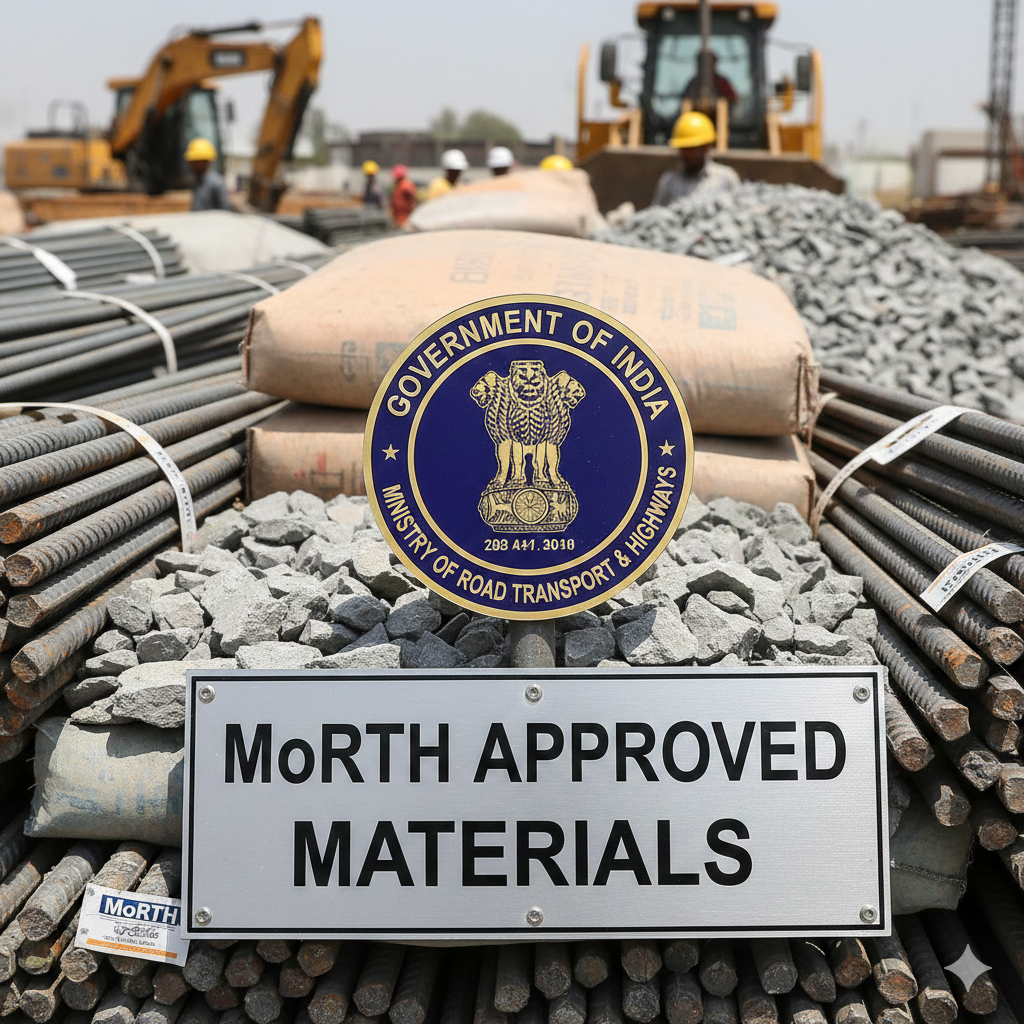
So, what exactly are “MoRTH approved materials“? These are special building blocks for roads that have passed very strict tests. They meet high-quality rules and standards set by MoRTH itself. You can find all these rules in a big book called “Specifications for Road and Bridge Works,” often just called “MoRTH Specifications.” When a material is MoRTH approved, it means it’s considered strong, safe, and perfect for building important roads like National Highways and other big projects across India. These materials act as a national benchmark for quality.
Following these MoRTH rules is super important. Why? Because it directly affects how long a road will last, how strong it is, how safe it is for drivers, and how well it works every day. These rules create a clear path for everyone, from government workers to building companies, to make sure all road projects are built consistently and reliably. We also need to understand other road construction materials MoRTH specifies to ensure every part of the road is up to par.
2. Why MoRTH Approval is Non-Negotiable for Superior Road Infrastructure
Using materials that are not good enough for road building can cause many serious problems. Imagine roads getting bad very quickly, full of potholes, and breaking down fast. This is exactly what happens with substandard materials. Roads lose their strength, making them unsafe for heavy trucks and even cars. This means we need to spend money on fixing them again and again, which costs public money. It also causes traffic jams, makes travel take longer, and sadly, leads to more accidents because of dangerous road conditions.
This is why MoRTH approved materials are so important. They are specially chosen and tested to make sure our roads last a long time and stay strong. For example, the stones and gravel (called aggregates) used in roads are checked to see if they are tough and can handle wear and tear. The sticky tar (bitumen) that holds everything together is tested for how well it binds and how it acts in hot or cold weather. Concrete is tested for its strength when squeezed or bent. Using these high-performance materials means our roads can handle lots of traffic, tough weather like heavy rain (monsoon) or extreme heat, and other stresses. This guarantees the road’s strength and stability for its entire planned life.
MoRTH rules are not just suggestions; they are must-dos for any road project that MoRTH pays for or supervises. These rules are written into all the important papers when building starts, like tender documents and contracts. This means everyone involved in the project is responsible for following the rules. It makes sure that money is spent wisely, that everything is done openly, and that there are clear ways to hold people accountable. This protects the public’s money and builds trust that our roads are built to the best standards using road construction materials MoRTH approves.
3. Deciphering the MoRTH Approved Material List: A Comprehensive Framework
When people talk about the “MoRTH approved material list,” it’s not simply a shopping list of items. Instead, it’s a huge, detailed set of guidelines found in the “Specifications for Road and Bridge Works.” This document is always being updated to include new ideas and better ways of building. It’s currently in its 5th edition and continues to be reviewed. It tells us exactly what materials to use, how to test them, and how to build different parts of roads and bridges. It acts as a detailed guidebook for engineers, contractors, and quality checkers.
MoRTH’s specifications cover almost every single material used in building a road. Here are some of the main types:
-
- Aggregates: These are the stones, gravel, and sand that make up most of the road’s body. They can be coarse (bigger stones) or fine (sand).
-
- Bituminous Materials: This refers to different types of tar or asphalt used to bind the road materials together. This includes various grades of paving bitumen, specially modified bitumen, and liquid bitumen forms like cutback and emulsions.
-
- Cement and Concrete: These are used for making strong, hard surfaces, bridges, and other structures. There are different types of cement and various strengths of concrete, along with additives to make them perform better.
-
- Steel Reinforcement: Strong steel bars are used inside concrete to make bridges and other structures even stronger.
-
- Geosynthetics: These are special fabrics and grids (like geotextiles, geogrids, geomembranes, geocells) used to make the ground stronger, separate layers, or help with drainage.
-
- Soil Stabilizers: Materials like lime, cement, or fly ash are mixed with soil to make the ground stronger and more stable for the road foundation.
- Other Materials: This broad category includes things like road paint, reflective signs, road barriers (road furniture), materials for pipes under roads (culverts), drainage systems, special fillers for gaps, and parts for bridge supports (bearings).
These specifications are carefully chosen to match how and where they will be used. This makes sure that the right road construction materials MoRTH specifies are picked for each part of the road. For instance, different materials are needed for the very bottom layer (subgrade), the layer above it (sub-base), the main support layer (base course), and the top driving surface (wearing course), as well as for bridges and other structures.
The information for this comprehensive framework comes directly from the official documents of the Ministry of Road Transport and Highways (MoRTH), especially their “Specifications for Road and Bridge Works.” [Official MoRTH Specifications Document]
4. The Rigor Behind Quality: An Overview of MoRTH Material Testing
“MoRTH material testing” is like a super important check-up for all road building materials. It’s the main way we make sure that every single material meets the strict rules set by MoRTH. This ensures the road will perform well and last for a very long time. The ways to do these tests are written down very carefully in the MoRTH Specifications. Often, these specifications also point to other important rules called Indian Standard (IS) codes, which come from the Bureau of Indian Standards (BIS).
Testing happens in different steps to make sure quality is checked at every point:
-
- Before Buying (Pre-approval/Source Approval): Even before large amounts of material are bought, the places where they come from (like stone quarries, oil refineries for bitumen, or cement factories) are checked. Samples are taken and tested to make sure the materials are consistently good and that enough quality material can be supplied.
-
- Regular Checks During Making/Supplying (Routine Quality Control): While materials are being made or delivered, small samples are tested regularly. This ensures that the material is the same every time and has the right properties. For example, checking the size of stones (aggregate grading) or the properties of bitumen.
- Tests at the Building Site (Site-Specific Testing): When materials arrive at the road building site, they are tested again. This checks that what was delivered is actually good quality. Also, parts of the road that have already been built are tested in place. This includes checking how tightly the layers are packed (field density) or how thick they are. For materials like concrete, small blocks (cubes) are made and tested for strength. For asphalt, samples are tested for stability.
For the most important tests and when an outside check is needed, the testing must be done in special labs. These labs are approved by an organization called the National Accreditation Board for Testing and Calibration Laboratories (NABL). This ensures that the tests are fair and the results are very accurate.
Here are some examples of specific tests done on different materials:
-
- For Aggregates (Stones and Gravel):
- Aggregate Crushing Value (ACV), Los Angeles Abrasion Value (LAAV), Aggregate Impact Value (AIV): These tests check how strong the aggregates are and if they can resist breaking when crushed or hit.
- Flakiness and Elongation Index: These tests check the shape of the stones to make sure they are not too flat or too long, which can make a road weaker.
- Soundness Test: This test checks if the aggregates can handle changes in weather without breaking apart.
- Sieve Analysis: This test checks the sizes of the different stones and gravel to make sure they are mixed correctly.
- For Aggregates (Stones and Gravel):
-
- For Bitumen (Tar):
- Penetration Test, Softening Point Test, Ductility Test, Viscosity Test, Flash Point Test: These tests check how thick or soft the bitumen is, how it reacts to different temperatures, how flexible it is, and how safe it is to use.
- For Bitumen (Tar):
-
- For Concrete:
- Compressive Strength (on cubes/cylinders), Flexural Strength (on beams): These tests measure how much pressure concrete can handle before it cracks or breaks.
- Slump Test: This checks how easily the wet concrete can be worked with.
- Water-Cement Ratio: This measures the amount of water compared to cement, which affects the concrete’s strength.
- For Concrete:
- For Soil:
- California Bearing Ratio (CBR): This test measures how strong the soil is for supporting the road above it.
- Atterberg Limits (Liquid Limit, Plastic Limit): These tests help understand how much water soil can hold and how it behaves.
- Proctor Compaction Tests: These tests help find the best way to press the soil tightly together for a strong foundation.
This careful, step-by-step testing process makes sure that all road construction materials MoRTH specifies truly meet the high standards. It gives everyone confidence that the materials will work as planned, helping to build strong, safe, and long-lasting roads.
These testing procedures are detailed in MoRTH Specifications and often refer to Indian Standard (IS) codes from the Bureau of Indian Standards (BIS). [BIS Website for IS Codes Example]
5. Key Categories of MoRTH-Compliant Road Construction Materials: A Deeper Dive
Let’s look more closely at some of the most important MoRTH approved materials and what makes them special.
Aggregates
Aggregates are like the skeleton of a road. They make up most of the road’s structure. MoRTH has very exact rules about the size and shape of these aggregates for different layers of the road. For example, for the granular sub-base layer, the wet mix macadam, or the top bituminous concrete layer, specific grading (mixture of different sizes) is needed. MoRTH also checks physical properties like how well they resist crushing, how tough they are against wear (abrasion resistance), and if they can handle weather changes (soundness). All these checks ensure the road is stable, strong enough to transfer the weight of vehicles, and can resist wear and tear over time.
Bituminous Binders
Bitumen, often called tar or asphalt, is the glue that holds the aggregates together. MoRTH lists different types (called grades) of bitumen, such as VG-10, VG-20, VG-30, and VG-40. Each grade is best for different weather conditions and how much traffic the road will carry. For roads with very heavy traffic or in extreme weather, MoRTH also specifies special types of bitumen. These are called modified bitumen, like Polymer Modified Bitumen (PMB) or Crumb Rubber Modified Bitumen (CRMB). These modified types are even better because they make the road more flexible, prevent cracks from tiredness (fatigue resistance), stop ruts from forming, and handle temperature changes better. This is crucial for long-lasting roads.
Cement and Concrete
Cement and concrete are used to make very hard, strong parts of the road, especially for rigid pavements, culverts (pipes under roads), and bridges. MoRTH explains which types of cement (like OPC 43, OPC 53, or PPC) should be used based on how strong the structure needs to be. It also gives rules for how to mix concrete, how strong it should be (e.g., M-30 concrete for rigid pavements), how durable it needs to be, and how to check its quality. This ensures that concrete parts of the road and its structures are solid and will last.
Steel Reinforcement
For parts of roads and bridges that use concrete, like bridges and culverts, steel bars are added to make them much stronger, especially against pulling forces (tension). MoRTH specifies special types of high-strength steel bars (like Fe 500D) that must follow standards from BIS (Bureau of Indian Standards). These rules ensure the steel has enough strength, can bend a little without breaking, and sticks well to the concrete, all of which are vital for the structure’s safety and strength.
Embankment and Subgrade Materials
The very bottom layers of the road, the embankment (raised ground) and subgrade (prepared ground beneath the road), are super important foundations. MoRTH has clear guidelines for choosing, testing, and pressing down (compacting) the soil and earth materials used here. These rules cover things like the size of soil particles, how plastic or sticky the soil is (plasticity index), its strength (California Bearing Ratio or CBR), and how tightly it needs to be packed. A good foundation ensures the road has enough strength to carry weight and stays stable.
Each of these “MoRTH approved materials” plays a special and critical role. Aggregates give the road its main strength, bitumen holds everything together and adds flexibility, cement creates hard and rigid structures, steel strengthens concrete against pulling apart, and a stable subgrade provides a firm base. When all these materials meet MoRTH’s standards and work together, they create a road that is very strong, robust, and designed to last a long time. These practices are also guided by Indian Road Congress (IRC) guidelines and Bureau of Indian Standards (BIS). [IRC Guidelines Example] [BIS Standards Example]
6. Benefits of Adhering to MoRTH Standards: A Vision for Sustainable Infrastructure
Following MoRTH standards and using “MoRTH approved materials” brings many great benefits, helping us build roads that last and support our country’s future.
Enhanced Safety
High-quality roads built with MoRTH-approved materials are smoother and have proper drainage. This means fewer potholes, fewer uneven spots, and a stable surface. All of this greatly reduces the chances of accidents caused by poor road conditions or sudden structural failures. Safer roads mean safer journeys for everyone. https://nhaiconsultants.com/nhai-highway-safety-protocols-guide
Extended Service Life
By using strong, durable, and carefully tested materials, roads can last for their full expected lifespan, sometimes even longer. This means we don’t have to rebuild or make big repairs very often. This fits well with government plans like the Bharatmala Pariyojana, which aims to build long-lasting and efficient roads across India.
Reduced Maintenance Costs
Investing in quality materials and proper construction according to MoRTH standards at the beginning saves a lot of money in the long run. There will be fewer small repairs and big overhauls needed throughout the road’s life. This frees up money that can then be used for other important projects to develop our country.
Environmental Considerations
When roads last longer, we don’t need to dig up new raw materials as often to build new ones. This means less energy is used in construction and reconstruction, and less waste is produced. MoRTH also encourages using materials that are friendly to the environment and even recycled materials when they are suitable and safe. This makes our road building more sustainable.
Cost-Effectiveness in the Long Run
While using top-quality materials might seem a little more expensive at first, it’s actually cheaper in the long run. Because roads last longer, need fewer repairs, and work better for traffic, the total cost over many years is much less. It’s a smart investment that pays off over time.
Economic Growth
A network of good, reliable roads built with “MoRTH approved materials” makes it easy and quick to move goods and people. This cuts down on how much businesses have to spend on transport, helps trade grow, encourages tourism, and boosts industries. All these things play a big part in making our national economy stronger and helping India prosper.
7. Conclusion: Paving the Way with Confidence and Quality Road Construction Materials MoRTH
To sum it up, “MoRTH approved materials” are far more than just a set of rules. They are the very foundation upon which India builds its amazing road network. They are absolutely essential for making sure our roads are strong, safe, and durable. These materials are critical for building resilient infrastructure that can support all of India’s important national development goals.
It is incredibly important to choose materials wisely, to check their quality at every single step, and to follow all the strict “MoRTH material testing” rules. Doing this helps us build high-performance roads that are robust and will last for many years to come. This ensures we are using quality road construction materials MoRTH has certified.
MoRTH’s rules are always being updated. https://nhaiconsultants.com/morth-circulars-guide-updates They include the newest discoveries in material science, better ways to build roads, and new ideas for protecting our environment. This shows a constant commitment to building the best possible infrastructure. By sticking to these high standards, we are making sure that India’s roads are built to the very best quality for a safer, more connected, and more prosperous future for everyone.
Frequently Asked Questions
Q1: What does MoRTH stand for?
A1: MoRTH stands for the Ministry of Road Transport and Highways. It is the apex body responsible for planning, developing, and maintaining India’s national highway network and regulating road transport.
Q2: Why are MoRTH approved materials important for road construction?
A2: They are critical because they ensure roads are built to high standards of durability, safety, and longevity. Using approved materials minimizes breakdowns, reduces maintenance costs, and ultimately contributes to safer and more efficient infrastructure.
Q3: Where can I find the specifications for MoRTH approved materials?
A3: The detailed specifications are outlined in the official “Specifications for Road and Bridge Works” document published by MoRTH. This document is regularly updated and is the primary reference for all road construction projects in India.
Q4: What kind of testing do MoRTH materials undergo?
A4: Materials undergo rigorous testing at various stages: pre-approval, routine quality control during supply, and site-specific testing. This includes tests for strength, durability, resistance to wear and weather, and physical properties, often conducted in NABL-accredited laboratories.
Q5: How do MoRTH standards contribute to economic growth?
A5: By ensuring the construction of high-quality, reliable roads, MoRTH standards facilitate smoother and faster transportation of goods and people. This reduces logistics costs for businesses, boosts trade, promotes tourism, and supports industrial growth, all contributing to a stronger national economy.